




A benchmark test for the global Vivo X500 shows the smartphone running on MediaTek’s Dimensity 9500 processor instead of the recently unveiled Dimensity 9600M chip ahead of its international debut.
Key points
- A Geekbench listing for the global Vivo X500 shows the device running Android 17 with 12GB of RAM.
- The benchmark data ties the device motherboard to the Dimensity 9500 rather than the newer Dimensity 9600M.
- Both 3nm chips share near-identical core configurations, memory support, and GPU components.
- Regulatory certifications confirm the global handset features 90W fast charging ahead of its international release.
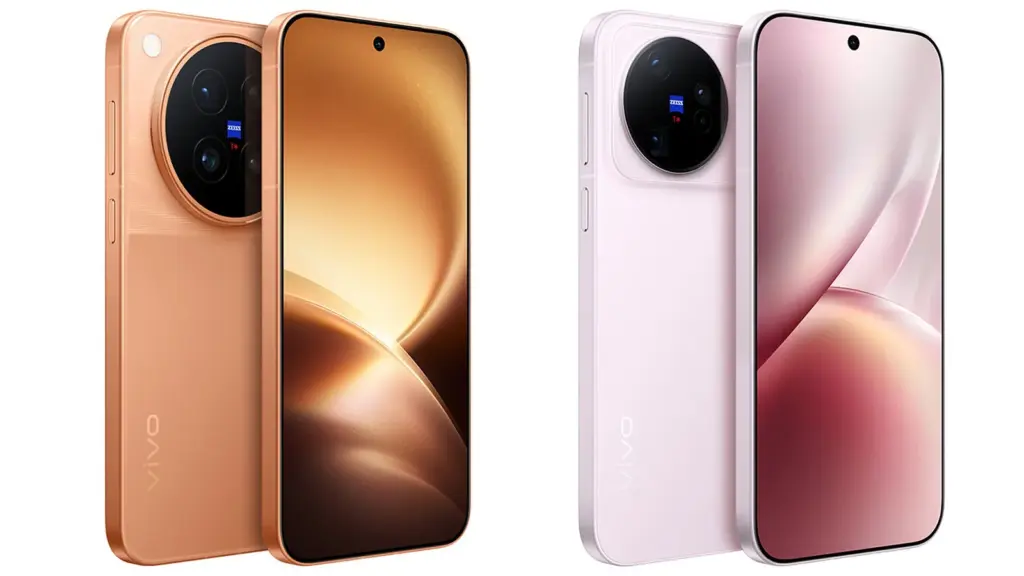
The Geekbench 7 entry, shared by tech tipster Anvin, lists the international handset under model number V2619. While earlier reports suggested the base model would adopt MediaTek’s latest silicon, the test records point to the previous generation platform. The device ran Android 17 with 12GB of RAM during testing.
Motherboard Data Points to Older Platform
The benchmark details an All-Big-Core CPU architecture composed of one ARM C1-Ultra prime core running at 4.21 GHz, three performance cores at 3.50 GHz, and four efficiency cores clocked at 2.70 GHz. Graphics are managed by an ARM Mali-G1 Ultra MC12 GPU. This layout closely matches the Dimensity 9500 configuration that MediaTek introduced last year.
The specific distinction between the two chips appears in the underlying hardware tag. The benchmarked device features the “k6993v1_64” motherboard identifier, a code specifically assigned to the Dimensity 9500. By comparison, the newer Dimensity 9600M utilizes the identifier “k6993v2_64”.
Architectural Parity Between Chipsets
Despite the differing motherboard identifiers, technical variations between the Dimensity 9500 and the Dimensity 9600M remain minimal. MediaTek built the top-tier Dimensity 9600 Pro on a 2nm node, but the company produced the standard 9600M on a 3nm process that functions primarily as a revision of the Dimensity 9500 architecture.
Because both chip designs share core blueprints, day-to-day operations should remain equivalent across devices. Both processors offer the following hardware features:
- Support for high-speed LPDDR5X memory and UFS 4.1 storage
- Integration with MediaTek’s NPU 990 for on-device artificial intelligence processing
- Compatibility with WQHD+ displays operating at refresh rates up to 180Hz
- Camera pipeline support for up to 320MP image sensors and 8K video capture
Global Certifications and Lineup Context
The base Vivo X500 joins a three-model family that also includes the X500 Pro and X500 Pro Max. While the standard edition relies on the 3nm platform, the higher-tier Pro Max model steps up to the 2nm Dimensity 9600 Pro. The OPPO Find X10 is also slated to use the same 3nm silicon tier for its standard variant.
The global V2619 variant has already appeared across several international databases, confirming that multiple regional models of the Vivo X500 are nearing market availability. A TÜV certification confirmed the device supports 90W wired fast charging, alongside approvals from regulatory authorities in Malaysia, Singapore, Indonesia, and the United Arab Emirates.
Vivo is scheduled to introduce the X500 series in China on September 21, 2026. The company has not yet confirmed whether international retail units will retain the Dimensity 9500 or ship with updated 9600M branding once global sales begin.