




Early benchmark results show graphics performance for Apple’s M5 Ultra processor approaches high-end desktop hardware, narrowing the gap with Nvidia’s GeForce RTX 5080 in raw compute workloads.
Key points
- Apple's M5 Ultra scored up to 220,000 points in Geekbench OpenCL tests, trailing Nvidia's desktop RTX 5080 by roughly 40,000 points.
- The chip posted an approximate 57 percent improvement in OpenCL compute performance compared to the prior M3 Ultra.
- In Apple's proprietary Metal benchmark, the M5 Ultra reached scores between 350,000 and 360,019 points.
- Configurations for the M5 Ultra Mac Studio start at $5,499 and support up to 512GB of unified memory.
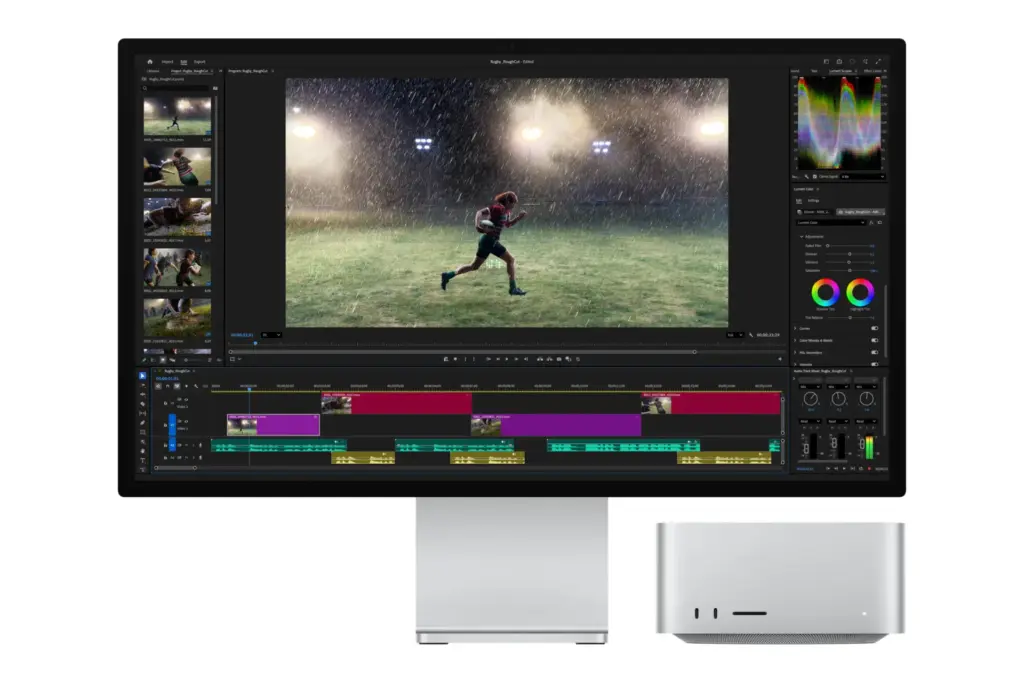
The listings appeared in the Geekbench database following Apple’s unveiling of the refreshed Mac Studio with M5 Max and M5 Ultra. The figures provide the first public look at how the company’s highest-tier desktop processor competes against discrete PC graphics cards in cross-platform testing.
Geekbench OpenCL and Metal Test Results
In Geekbench 7 OpenCL compute tests, the M5 Ultra posted scores ranging between 210,000 and 220,000 points. The desktop Nvidia GeForce RTX 5080 scores approximately 250,711 to 260,000 points on the same cross-platform test. While the RTX 5080 retains a lead, the M5 Ultra delivered an approximate 57 percent performance increase over the M3 Ultra, which scored 140,821 points.
In Apple’s proprietary Metal API benchmark, the M5 Ultra inside Mac Studio model identifier Mac17,15 reached between 350,000 and 360,019 points. The previous-generation Mac Studio featuring an 80-core M3 Ultra scored between 249,564 and 255,009 points in the same test. Because the Metal API is exclusive to Apple platforms, direct comparisons against Nvidia hardware on that test are not possible.
| Processor / Graphics Card | Geekbench OpenCL Score | Geekbench Metal Score |
|---|---|---|
| Apple M3 Ultra (80 GPU cores) | ~140,821 | ~249,564 |
| Apple M5 Ultra (80 GPU cores) | ~220,000 | ~360,019 |
| Nvidia GeForce RTX 5080 | ~260,000 | N/A |
Architectural Specs and Artificial Intelligence Workloads
The M5 Ultra relies on a quad-die configuration that pairs up to a 36-core CPU with an 80-core GPU. The processor also includes a Dual Neural Engine with dedicated per-core Neural Accelerators designed to process local artificial intelligence models and high-throughput machine learning tasks.
Workstation buyers can configure the M5 Ultra Mac Studio with up to 512GB of unified memory. Because the CPU and GPU share this pool of high-bandwidth memory directly, the system can run larger AI models entirely in system RAM without encountering the memory constraints common on standard consumer graphics cards.
Power Draw and Efficiency Differences
A central distinction between the two platforms remains electrical power consumption. Desktop systems running an Nvidia RTX 5080 can draw more than 600W under heavy computational loads when factoring in the total host system.
Apple has not released exact wattage figures for the M5 Ultra under maximum sustained load. However, previous M3 Ultra systems operated under 200W total desktop draw during peak workloads, indicating the M5 Ultra retains a substantial efficiency margin over full-tower desktop setups running dedicated graphics cards.
Mac Studio Pricing and Generation Context
Apple skipped an Ultra-class processor during the M4 generation, leaving the M3 Ultra as the previous benchmark for the Mac Studio. The newer M5-generation models went on sale starting at $2,499 for M5 Max configurations and $5,499 for the M5 Ultra, with fully loaded configurations priced up to $12,299.