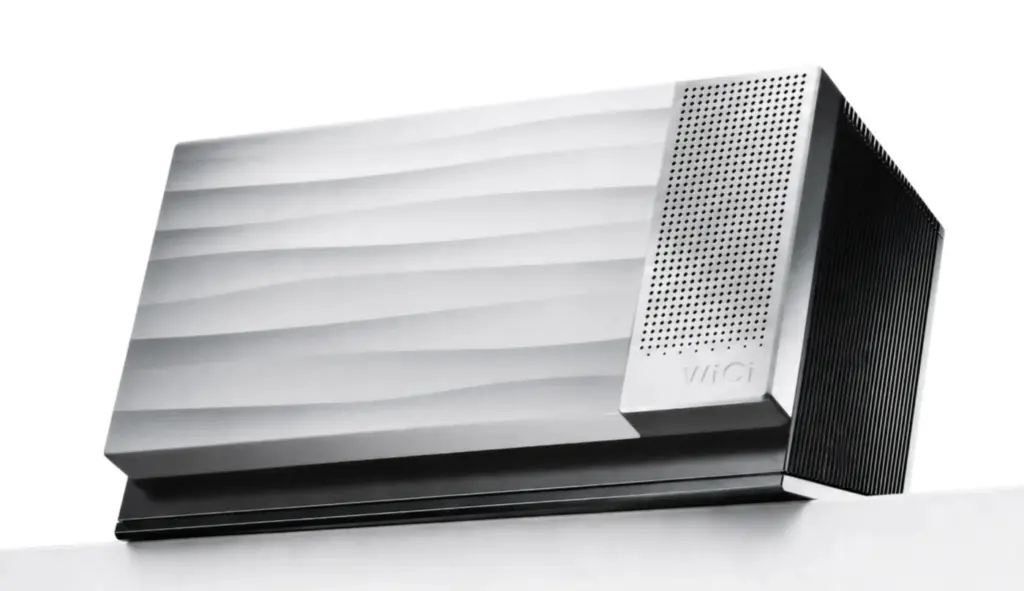
Hardware startup WiCi, a member of Nvidia’s Inception accelerator program, has introduced the WiCi One, an external graphics processing unit that streams desktop graphics over a wireless network rather than a physical tether.
Key points
- The WiCi One uses Wi-Fi 7 to stream desktop graphics processing wirelessly to nearby laptops and client computers.
- Base configurations include an Nvidia GeForce RTX 5060 Ti 16GB graphics card, Intel Core 3 100U processor, and 1TB storage.
- Wi-Fi 7 throughput reaches roughly 11.5Gbps, requiring custom compression drivers to prevent processing bottlenecks.
- Early access pricing starts at $1,999 before an official retail increase to $2,599 in the fourth quarter of 2026.
External graphics cards traditionally rely on high-bandwidth copper or optical cables plugged directly into a host laptop. By shifting to wireless transmission, the WiCi One allows compatible client devices to offload rendering and compute tasks over local airwaves, while also serving as a shared local hardware accelerator.
Hardware Architecture and Bandwidth Limits
Rather than functioning solely as a passive graphics dock, the WiCi One is constructed as a standalone small-form-factor computer. The base configuration contains an Nvidia GeForce RTX 5060 Ti 16GB graphics card, an Intel Core 3 100U processor, and 1TB of NVMe Gen 4 solid-state storage housed inside a compact enclosure.
Transmitting real-time graphics over wireless bands presents strict throughput limits compared to standard external GPU interfaces. The physical layer throughput of WiCi’s Wi-Fi 7 setup falls well below wired alternatives:
| Connection Standard | Peak Physical Throughput | Physical Medium |
|---|---|---|
| Wi-Fi 7 (4×4 MIMO, 320 MHz) | ~11.5Gbps | Wireless |
| Thunderbolt 4 | 32Gbps (PCIe) | Wired Cable |
| Thunderbolt 5 / OCuLink | Up to 64Gbps (PCIe) | Wired Cable |
Because physical-layer bandwidth is capped near 11.5Gbps on a 320 MHz channel, the system cannot match the direct bus access provided by a standard PCIe cable connection.
Driver Compression and Gaming Performance
To operate within wireless throughput limits, WiCi engineered specialized driver software to manage data transmission. The host driver carries out data deduplication, memory caching, and frame compression before broadcasting packets across the network.
Under this software model, the client computer processes basic hardware instructions locally, transmitting only essential graphics commands over the air to the enclosure. WiCi claims the setup can achieve 80 frames per second in Cyberpunk 2077 at 4K resolution using Ultra settings and DLSS 4, alongside 60 frames per second in Black Myth: Wukong. Even with compression, maintaining low frame latency remains an obstacle, as real-time 60Hz video rendering requires complete frames to arrive every 16.67 milliseconds.
Local AI Workloads and Multi-User Pooling
WiCi is also marketing the machine as a local compute hub for artificial intelligence tasks and 3D rendering. The enclosure integrates a 4TB PCIe 5.0 SSD intended to store local Mixture-of-Experts model parameters directly on the device.
Using custom Python libraries and standard HTTP application programming interfaces, several laptops on the same local area network can queue tasks and access the graphics card concurrently. This pooling setup allows multiple low-power client machines to share GPU resources for non-gaming workloads without requiring dedicated cloud server subscriptions.
Pricing and High-End Variant Plans
The base WiCi One enclosure is available through an early access period priced at $1,999. Following the early access window, the retail price will increase to $2,599 when the product launches broadly in the fourth quarter of 2026.
WiCi has also detailed plans for an enthusiast-tier version of the system. That planned model will incorporate an Nvidia GeForce RTX 5090 graphics card featuring 32GB of GDDR7 memory, paired with an Intel Core Ultra 7 255H processor and 4TB of PCIe 5.0 storage.