




A new hardware leak suggests Sony is developing a dedicated portable console to accompany its next generation of hardware, featuring PlayStation Spectral Super Resolution 3.0 and a higher-clocked docked mode.
Key points
- A hardware report outlines an unannounced Sony portable console codenamed Project Canis running a custom AMD processor.
- The device reportedly relies on 540p internal rendering upscaled to 1080p via PlayStation Spectral Super Resolution 3.0.
- Docked mode frequencies reportedly raise GPU clock speeds up to 1.65GHz for higher computing throughput.
- Hardware leaker KeplerL2 disavowed the leaked specifications, stating no new portable data had been shared in months.
- Broader supply chain constraints around memory chips could push any next-generation PlayStation release beyond late 2027.
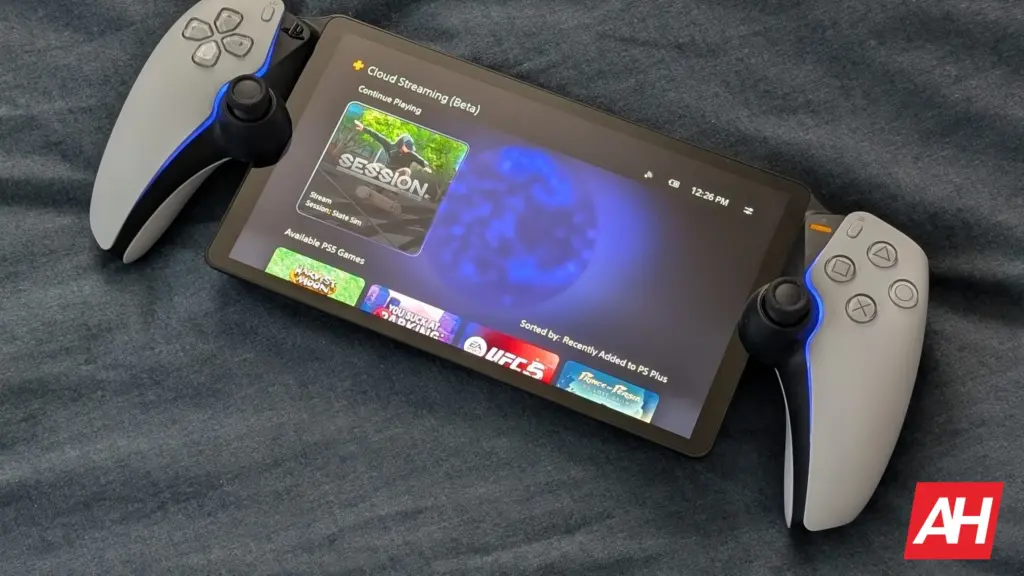
The details outline an unannounced portable system designed to bridge native handheld play with higher-power home use. If accurate, the device would represent Sony’s first dedicated native handheld hardware since the PlayStation Vita, diverging from the streaming-only architecture of the PlayStation Portal.
Docked Mode and Resolution Scaling Details
The leak, originating from hardware outlet GameGPU, details a system internally referred to as Project Canis. The portable unit reportedly features a custom AMD processor built on a 3-nanometer manufacturing process, pairing six Zen 6 central processing unit cores with 16 RDNA 5 graphics compute units and 24GB of LPDDR5X memory running across a 192-bit bus.
Operating profiles differ significantly between portable play and an external dock. In handheld mode, the graphics processor reportedly operates at 1.2GHz within a 15W thermal design envelope. When placed into a stationary dock, clock speeds increase to 1.65GHz, allowing the chip to operate at up to 25W.
Rather than pushing native high-definition rendering on the integrated screen, the system reportedly renders games at an internal resolution of 540p. Machine-learning algorithms then scale the image to a 1080p output target on the integrated panel or connected monitors, as detailed in the Project Canis handheld leak.
PSSR 3.0 Machine Learning and Raw Compute Metrics
The report claims the system relies on an unannounced third iteration of Sony’s machine-learning upscaler, dubbed PSSR 3.0. Sony first deployed the PlayStation Spectral Super Resolution technology on the PlayStation 5 Pro to reconstruct higher-resolution frames from lower baseline images without increasing hardware power draw.
In raw compute terms, the leak lists the portable console at 4.91 teraflops in handheld mode and 6.75 teraflops when docked. The report asserts that applying PSSR 3.0 and integrated frame reconstruction delivers perceived performance equivalent to 11 teraflops on the move and 14 teraflops while docked.
By comparison, the standard PlayStation 5 Pro produces 16.7 teraflops of raw single-precision compute power. The purported portable figures remain speculative calculations based on upscaling efficiency rather than traditional hardware compute capacity.
| Metric | Handheld Mode | Docked Mode | PS5 Pro (Home Console) |
|---|---|---|---|
| GPU Clock Speed | 1.20GHz | 1.65GHz | 2.18GHz (approximate) |
| Raw Compute | 4.91 TFLOPs | 6.75 TFLOPs | 16.7 TFLOPs |
| Thermal Limit | 15W | 25W | Over 200W |
| Native Rendering Base | 540p | 540p | Variable (1080p to 1440p typical) |
| Target Output | 1080p | 1080p | Up to 4K |
Disputed Source Claims and Supply Chain Timeline
Industry observers have questioned the immediate credibility of the hardware leak. Hardware leaker KeplerL2, who was linked to the initial reporting, directly disavowed the publication, stating that they had not shared or updated portable specifications in months.
The leaked report also pointed to a late 2027 commercial release window. However, reporting from Bloomberg and earlier analyses of potential PlayStation 6 hardware delays indicate that next-generation timelines may slip into 2028 or 2029.
Escalating demand for high-bandwidth dynamic random-access memory from artificial intelligence data centers continues to tighten global component supplies. Hardware manufacturers face rising costs and constrained yields for low-power memory packages, which could influence release targets for consumer gaming devices.
Evolving Portable Strategy and PS5 Compatibility
Sony Interactive Entertainment has not verified the existence of Project Canis or published documentation regarding future portable products. Recent company communications have instead focused on software rollouts during regular PlayStation community events.
First-party studios remain committed to current-generation projects, including major narrative titles developed for PlayStation hardware ecosystems. Running modern titles natively on portable silicon requires significant software optimization, particularly if Sony expects backward compatibility across existing libraries.
Digital distribution will also determine how a future portable machine operates. Industry reports indicate that future consumer strategies for PlayStation hardware may increasingly favor disc-free formats and digital game distribution, aligning with a portable product that cannot accommodate physical disc media.